


Jewish Holidays
Jewish Calendar
In Jewish tradition, the day begins at sunset, so holidays are also celebrated in the evening. The reason can be found in the Torah, in the book of Bereishit (“Genesis”): “And there was evening and there was morning, the first day.”
The Jewish calendar is a combination of lunar and solar calendars. Months are calculated based on the movement of the Moon around the Earth, while days and years are based on the movement of the Earth around the Sun. Because of this, holidays according to the Jewish calendar fall on the same dates every year, while their dates in the Gregorian calendar change. At the same time, holidays always remain tied to their seasons, such as Passover in spring and Sukkot in autumn.
Significance of Jewish Holidays
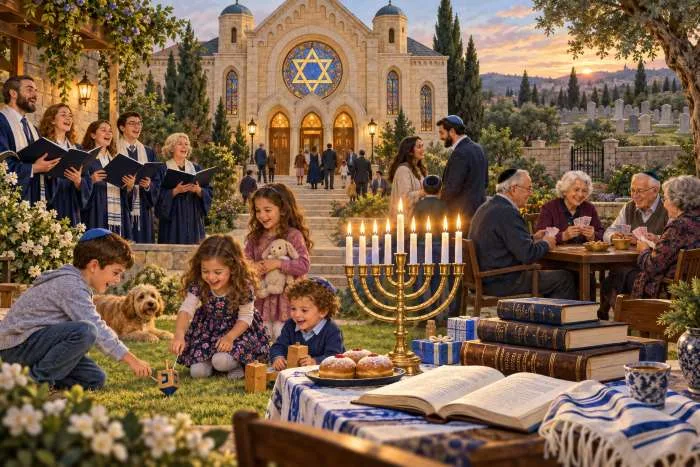
Jewish holidays represent an important part of the religious, historical, and cultural life of the Jewish people. They are an opportunity for prayer, remembrance, reflection, and spiritual growth, but also a time for joy, family, and community.
Each holiday has its own special story, symbolism, and customs. They are expressed through holiday prayers, songs, rituals, and traditional meals, and are passed down from generation to generation, thus preserving the connection to the history and tradition of the Jewish people.
Jewish holidays include major holidays, pilgrimage holidays, fast days, as well as holidays established in more recent history. Among them are Yom HaShoah, Yom HaZikaron, Yom Yerushalayim, and Yom Ha'atzmaut, which hold a special place in the contemporary life of the Jewish people.
Learn more about the holidays
Shabbat
09.10.2026.
Shabbat is a holy day of rest that begins on Friday at sunset and ends on Saturday, featuring prayer, family customs, and traditional rituals.
Rosh Hashanah
Rosh Hashanah is the Jewish New Year, a holiday celebrated at the beginning of Tishrei, associated with repentance, reflection, and hope for a good year.
Yom Kippur
Yom Kippur is the Day of Atonement, Repentance, and Forgiveness, observed through prayer, fasting, and reflection on one's actions and responsibilities.
Sukkot
Sukkot is a pilgrimage festival that commemorates the forty years of the Jews' wandering in the desert, along with customs related to the Sukkah and four spe…
Shemini Atzeret and Simchat Torah
Shemini Atzeret and Simchat Torah are holidays marking the conclusion of Sukkot and the annual Torah reading cycle, with traditional customs and celebrations.
Hanukkah
Hanukkah is a Jewish festival of lights and miracles, marked by lighting candles in the hanukkiah and commemorating the liberation and rededication of the Te…
Tu Bišvat
Tu Bišvat is the Jewish New Year of Trees, a holiday that marks the beginning of a new cycle for trees and highlights the importance of nature and its conser…
Purim
Purim is a Jewish holiday symbolizing the survival of the Jewish people, marked by reading the Scroll of Esther, giving, and festive customs.
Passover
Passover is a Jewish festival of freedom, celebrated in remembrance of the liberation of the Jews from Egyptian slavery, marked by the Seder dinner and tradi…
Lag Baomer
Lag Baomer is the thirty-third day of the Counting of the Omer, a holiday commemorating the victory of Bar Kochba and the end of the plague among Rabbi Akiva…
Shavuot
Shavuot is a Jewish festival of weeks and the giving of the Torah, celebrated on the 6th day of Sivan, symbolizing spiritual preparation and receiving the To…